Study at the University of Texas at Tyler
While I was in Dallas for the Myositis Association International Conference, I heard about a study for IBM patients being run at the University of Texas at Tyler—only about an hour from Dallas—so naturally, I signed right up. (If someone’s studying knees, balance, or gravity and wants to include those of us with IBM, I’m in.)
The official title of the study was a mouthful: “Knee extensor eccentric control for landing balance of stand-to-sit and its relationship with postural stability during perturbation responses to ground balance challenges.” Basically, they’re looking at how we control our knees when we sit down and how well we stay upright when the ground gets… mischievous. They’d already run it on people in their 70s and 80s before adding people with IBM. The short title—“Knee extensor eccentric control during stand-to-sit and postural stability during ground balance challenges”—was only slightly less intimidating.
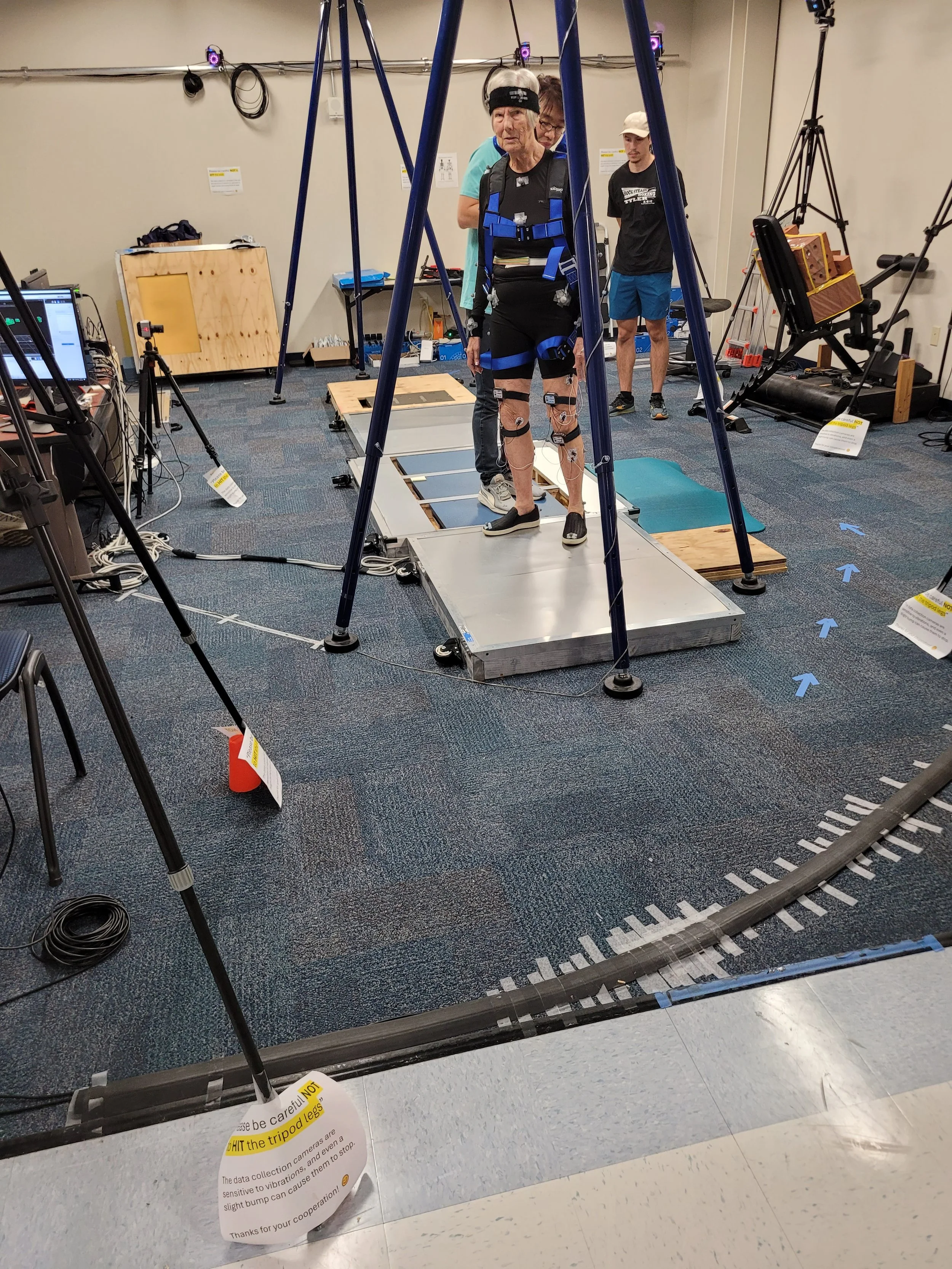
First, they handed me a special workout suit, then the interns began attaching what felt like hundreds of tiny sensors to me. Once I was fully decorated, they connected wires to each sensor. This alone took about 30 minutes. The goal? To build a “computer me” on the doctor’s laptop. While they fussed with that, I stared at the obstacle course I’d be walking through. It looked like someone had shrunk a Spartan Race and stuck it indoors.
After a dry run (and getting clipped into a safety sling like a baby learning to walk), the doctor watched the screen, squinted, and had the interns reposition a few sensors. Then they had me sit where I couldn’t see the course because they didn’t want me to watch them set up the “surprises.”
I passed the time chatting with the representative from Kourage Health and, apparently, shocking the entire room by revealing I have zero games on my phone. (Listen, I know myself. If I ever download Candy Crush, you’ll have to pry the phone out of my hands.)
When they were ready, they walked me back, hooked me up again, and told me to “walk through the course.” This is how horror movies start, but okay.
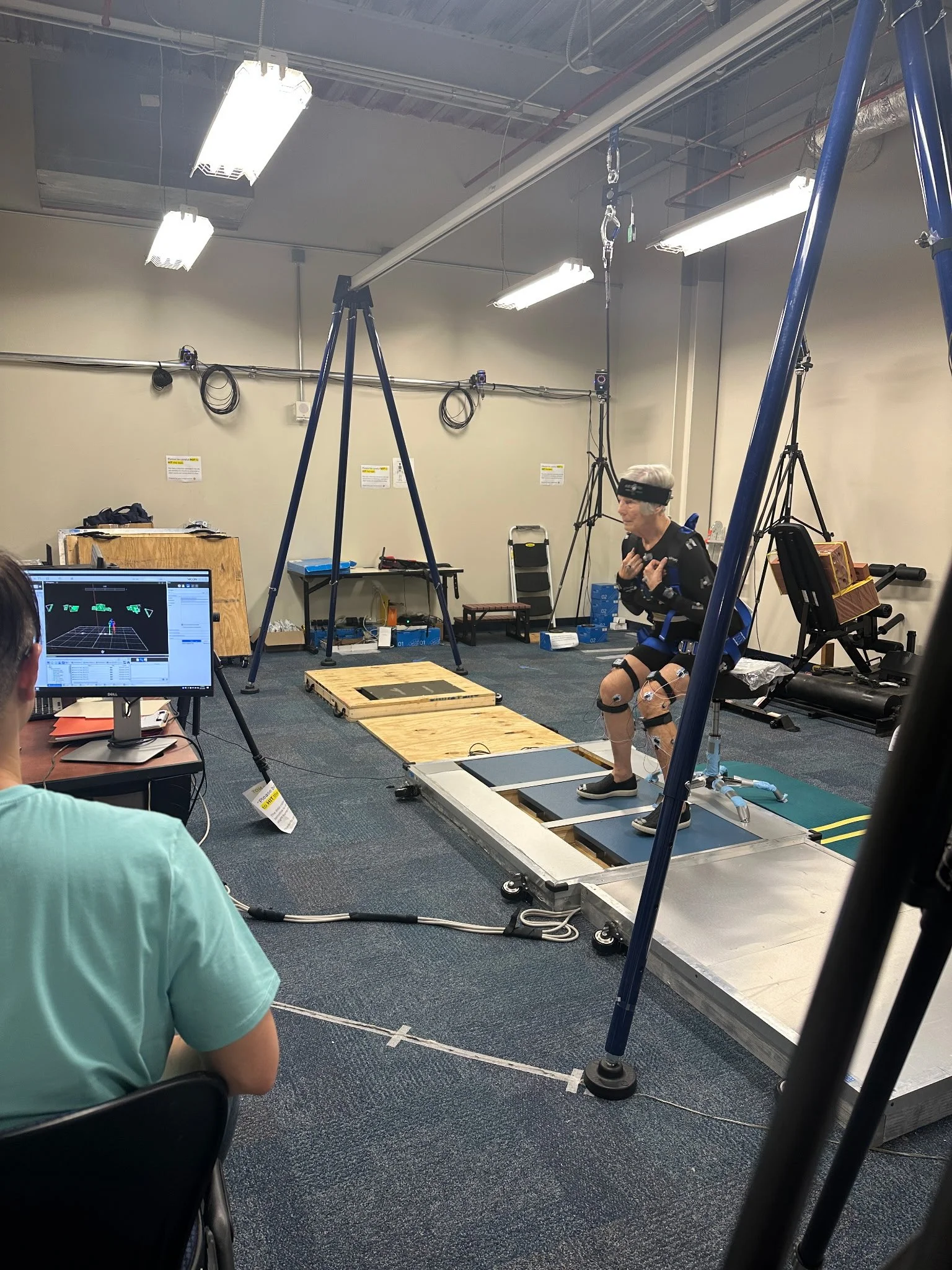
First came the “known obstacles.” They pointed to one section and told me it might “drop down” when I stepped on it. Cute. I stepped on the first one and—yep—it dropped a few inches. I caught myself easily and felt a tiny bit smug.
Then came the “unknown obstacles,” also known as “we’re not telling you anything now, good luck.” The next drop was bigger, and by the time an unexpected drop came on the fourth step, I was rocking like a tree in a windstorm. But thanks to all the balance work I’ve been doing, I managed to steady myself. I did need a moment to recover before moving on. I had no clue if more surprises were lurking, so I wanted my legs and nerves reset.
I’ll probably never see the results of that test, but honestly, I just found it fascinating that the study exists at all.
I’ve also wrapped up all my appointments for the testing at UC Irvine, and I’ll write about that adventure soon—because oh, there was an adventure.
My advice: start balance exercises early, keep doing them forever, and don’t wait for a disappearing floor to remind you why they matter.
“All we have to decide is what to do with the time that is given us.”
We have a bookshop store HERE where you can find books Linda has read or that look helpful for folks dealing with chronic diseases of various kinds. You may see links to those books in the text of our blog posts. We do get a small financial reward if you purchase a book through the shop, but the price to you is the same. It also helps support independent booksellers. Thanks!
This blog post is based on personal experiences and is not meant to provide medical advice.
Always consult your healthcare professional for personalized guidance on your health journey.